
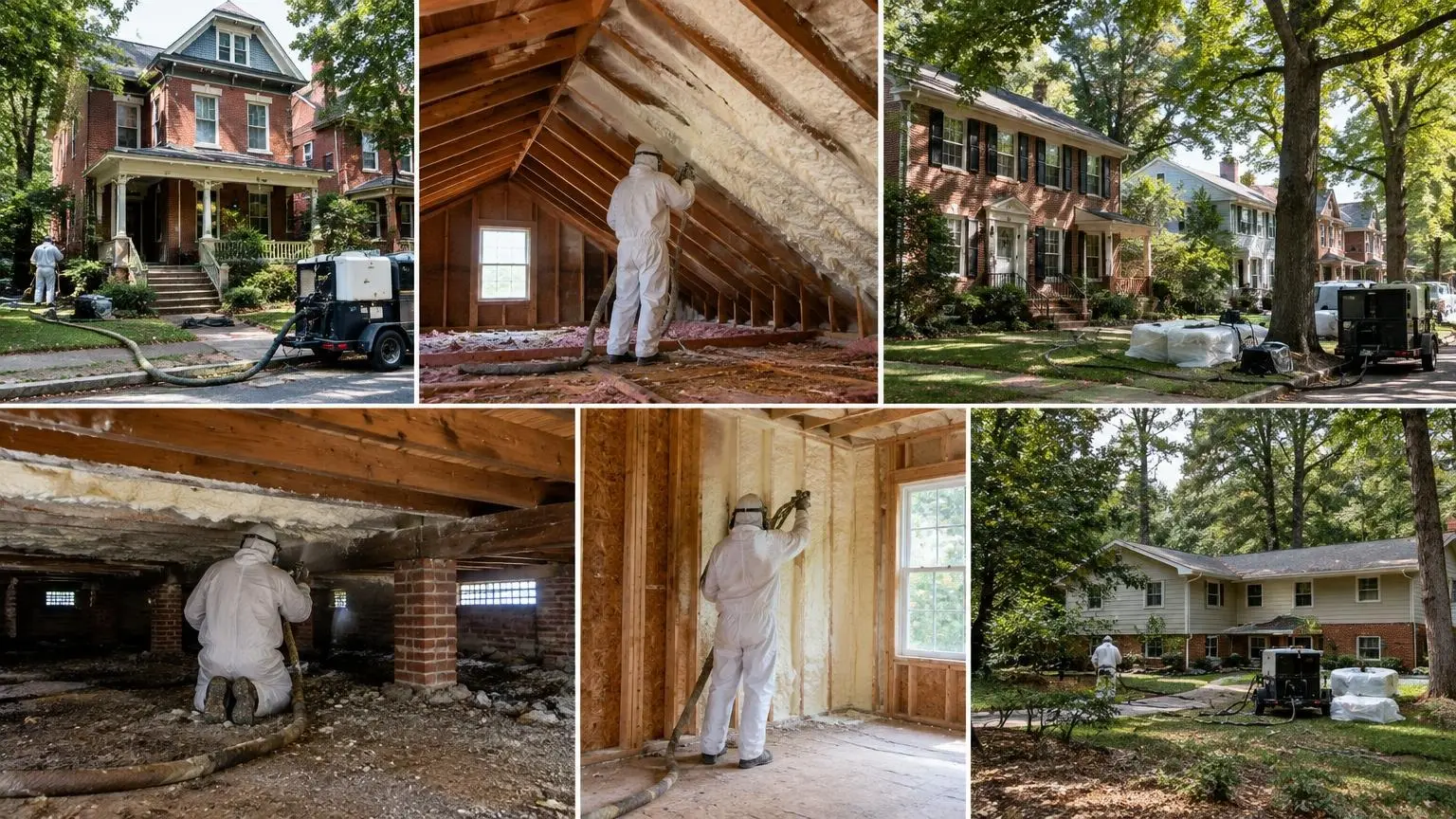
Open-cell and closed-cell foam
Spray Foam Insulation in Richmond, VA
Foam fills the cracks that batts and loose fill leave open, so it stops air and slows heat at the same time.
- Free on-site estimates
- Written, itemized quote with R-values
- Air sealing before any insulation goes in
Where Spray Foam Earns Its Cost
Spray foam insulation goes on as a liquid, expands within seconds and hardens in place. Because it fills every gap in the cavity, it seals air leaks as well as insulating, which loose fill and batts cannot do on their own. That makes it the strongest choice for some parts of a Richmond house and an expensive one for others, so the useful question is not whether foam is good but where it pays for itself.
Where foam is the right call
- Under the roof deck: turning a hot attic into a sealed, semi-conditioned space when ducts or an air handler live up there.
- Rim joists: the band of framing above the foundation, which leaks air in almost every house and is awkward to seal any other way.
- Crawl space walls: closed-cell foam on the foundation walls when the crawl space is being sealed.
- Bonus rooms and knee walls: the sloped ceilings and short walls over garages that run hot in July.
- Open walls during a remodel: studs exposed, wiring done, before drywall.
Open-cell versus closed-cell
Open-cell foam is light, soft and spongy, with roughly R-3.5 to R-3.7 per inch according to HomeGuide. It expands a lot, fills irregular spaces well and costs less. It lets water vapor pass through and can absorb water, and the Department of Energy advises against using it below ground level. Closed-cell foam is dense, rigid, and roughly R-5 to R-7 per inch. It resists moisture, adds stiffness, and needs less thickness for the same R-value, but it costs more per inch. In a Richmond crawl space or on a rim joist that touches masonry, closed-cell is usually the better fit. Under a roof deck, either can work, and the choice depends on depth available, budget and the roofing.
Our humid summers and the roof deck
When foam goes on the underside of the roof, the attic becomes part of the house's air space. That keeps ducts out of the summer heat that builds up in a vented attic, which is one of the main reasons people choose it here. It also means the attic is no longer vented, so we check the roof for leaks first, since foam can hide a slow drip until the sheathing is damaged, and we talk with you about how the space will be dried and conditioned. Some roofing manufacturers have specific requirements for shingles over a foamed deck, so it is worth checking your roof warranty terms.
Leaving the house during the job
Spraying creates isocyanate vapors that are harmful to breathe. The work area is closed off and ventilated, installers wear respirators, and occupants and pets leave. The EPA notes that some manufacturers recommend about 24 hours before re-occupancy for professional two-component systems, but the right time depends on the product, thickness, temperature and humidity. We give you the manufacturer's re-entry time for the foam we are using in writing, and we do not ask you to come back early.
What we check before quoting
We look at the space you want foamed, how much depth there is to work with, wiring that has to stay accessible, any existing insulation that must come out first, signs of past leaks, and how the area connects to the rest of the house. Spray foam is permanent and hard to remove, so we would rather talk you out of it in a spot where blown-in insulation does the same job.
What This Covers
Spray foam jobs usually target one or more of these areas.
Roof deck foam
Open-cell or closed-cell foam on the underside of the roof sheathing to bring the attic inside the envelope.
Rim joist sealing
Closed-cell foam along the band joist above the foundation, where air leaks are common.
Bonus rooms and knee walls
Foam on sloped ceilings, knee walls and the floor over a garage.
Open-wall and new framing
Foam in exposed stud cavities during remodels and additions, before drywall.
Typical Spray Foam Insulation Costs
| Item | Published range |
|---|---|
| Open-cell, installed | $1.50 to $3.50 per sq ft |
| Closed-cell, installed | $3.00 to $5.00 per sq ft |
| Attic (HomeGuide / Fixr, existing home) | $3,000 to $8,000 / $2,500 to $12,000 |
| Rim joists | $2,000 to $2,500 |
| Whole house | $8,000 to $20,000 (HomeGuide); $10,000 to $30,000 (Fixr) |
| Richmond, about 1,282 sq ft (Homeyou) | $1,981 to $2,477 |
National ranges from HomeGuide (2026) and Fixr (2025), plus Homeyou's Richmond customer-reported figure (2026). Many companies have minimum charges of $1,000 or more. Foam type, depth and access set the cost. Your written estimate is the price.
How It Works
1. Inspect and measure
We check the space, the depth available, the roof or foundation, and anything that must come out first.
2. Quote by area
You get each area with foam type, thickness, R-value and price, plus re-entry time.
3. Prepare and spray
We mask and cover the area, set up ventilation, and spray to the agreed depth while the house is empty.
4. Trim, ventilate and check
Overspray is trimmed, depth is checked, and the space is ventilated until the re-entry time has passed.
Spray Foam Insulation Questions
How long do I need to stay out after spray foam is installed?
It depends on the product. The EPA says some manufacturers recommend about 24 hours for professional two-component systems, and curing changes with thickness, temperature and humidity. We give you the manufacturer's re-entry time in writing before the job.
Should I use open-cell or closed-cell foam in my attic?
Both can work under a roof deck. Open-cell costs less and fills irregular spaces; closed-cell reaches a higher R-value in less depth and resists moisture. We recommend one based on rafter depth, roofing and budget, and explain why on the quote.
Does spray foam cause problems with the roof?
Foam on the roof deck can hide a leak until the wood is damaged, so we check the roof first. Some shingle manufacturers have specific terms for unvented roof assemblies; check your roofing warranty before deciding.
Is spray foam worth it for a Richmond home?
It is often worth it where air leaks are hard to reach or moisture matters: rim joists, crawl space walls, bonus rooms and attics holding ductwork. On a plain attic floor, air sealing and blown-in insulation usually give similar results for less.
Spray Foam Insulation Service Areas
- Spray Foam Insulation in Richmond, VA
- Spray Foam Insulation in Henrico, VA
- Spray Foam Insulation in Short Pump, VA
- Spray Foam Insulation in Glen Allen, VA
- Spray Foam Insulation in Mechanicsville, VA
- Spray Foam Insulation in Chesterfield, VA
- Spray Foam Insulation in Midlothian, VA
- Spray Foam Insulation in Chester, VA
- Spray Foam Insulation in Bon Air, VA
- Spray Foam Insulation in Petersburg, VA
- Spray Foam Insulation in Colonial Heights, VA
- Spray Foam Insulation in Hopewell, VA
- Spray Foam Insulation in Ashland, VA
- Spray Foam Insulation in Highland Springs, VA
- Spray Foam Insulation in Sandston, VA
- Spray Foam Insulation in Tuckahoe, VA
- Spray Foam Insulation in Powhatan, VA
- Spray Foam Insulation in Goochland, VA
Get a Spray Foam Insulation Estimate
Free on-site estimates for spray foam insulation.