
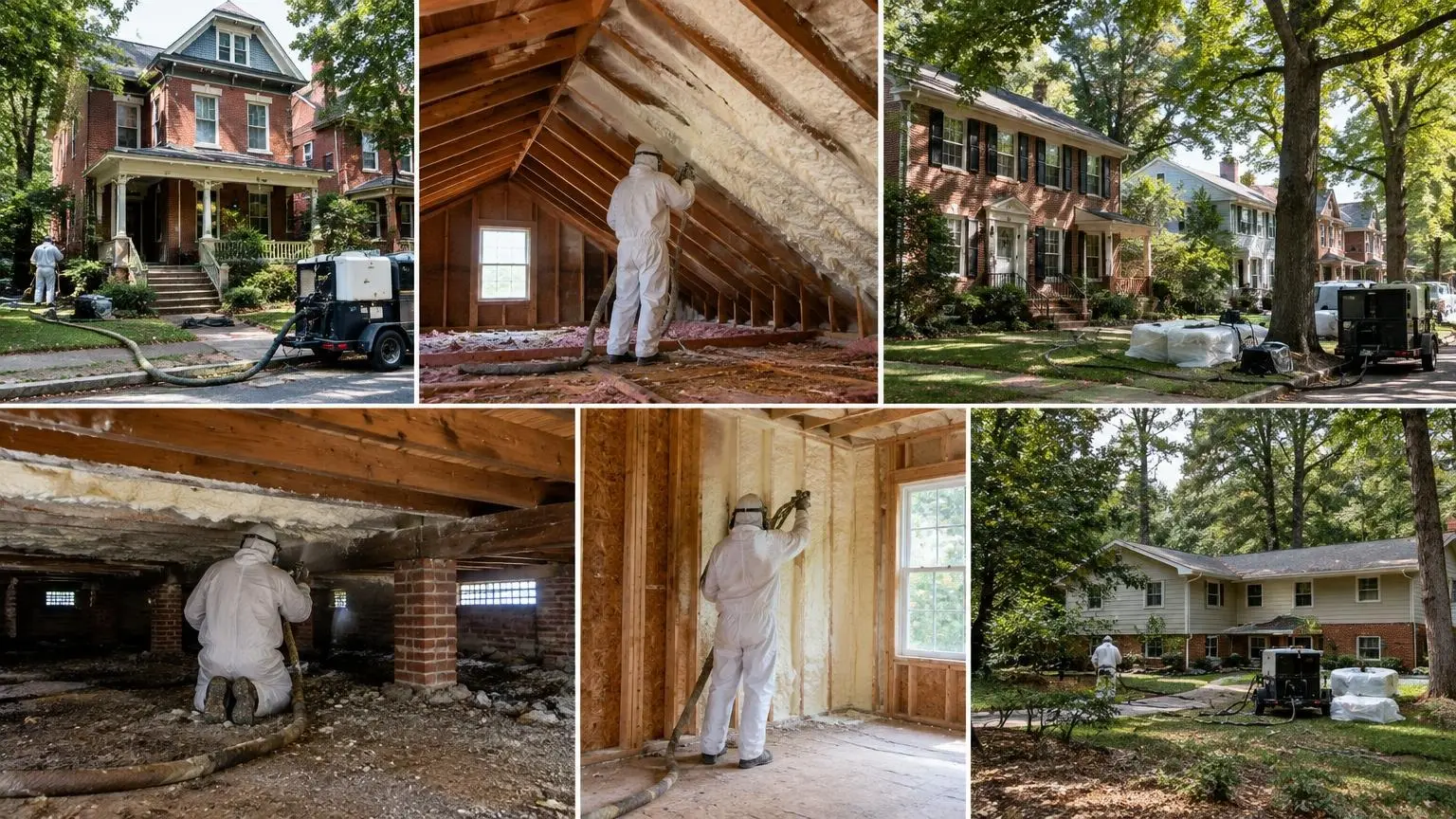
Chesterfield County suburbs along the old Midlothian Turnpike, now U.S. Route 60
Spray Foam Insulation in Midlothian, VA
Air sealing and insulation for the subdivision homes that spread across Midlothian after Swift Creek Reservoir opened in 1965, from the attic hatch down to the rim joist.
- Free on-site estimates
- Written, itemized quote with R-values
- Air sealing before any insulation goes in
Comfort Upgrades for Homes People Keep
Spray foam insulation in Midlothian usually goes into a house the owner plans to stay in. Census estimates for 2020 to 2024 put the owner-occupied rate at 73.5%, and 87.8% of residents were living in the same home a year earlier. When you expect to be in a house for a long stretch, it makes sense to fix the rooms that never feel right, rather than nudging the thermostat every July and January.
Subdivision houses and the rooms that run hot
Midlothian started as a coal-mining village, but most of today's housing came later. After mining declined, subdivisions spread, helped by Swift Creek Reservoir, created in 1965 to supply water and sewer service, and Brandermill, the planned community on Swift Creek Reservoir, was built starting in 1975. Large neighborhoods such as Salisbury followed the same suburban pattern. Two-story homes of that kind tend to share a few weak spots:
- A finished room over the garage with a cold floor in winter and a stuffy ceiling in summer
- Knee walls along an attic that were insulated with batts but never covered on the attic side
- Recessed lights, bath fans and plumbing chases that leak air straight into the attic
- An attic floor where blown-in insulation has settled or been pushed aside by later wiring and duct work
Where spray foam earns its place here
We do not foam an entire house just because foam is on the truck. In a typical Midlothian two-story, closed-cell foam makes the most sense at the rim joists, in the floor over a garage, and at knee walls, where air leakage does more damage than a lack of fluffy insulation. Open-cell foam can work well on a roof deck when a homeowner wants to bring an attic inside the conditioned space, such as one holding a furnace and ducts. On a wide-open attic floor, blown-in insulation over careful air sealing often gives the best result for the effort. We will walk through those choices with you and put them in writing.
The ceiling rule Chesterfield adopted
All of Midlothian is in Chesterfield County, which has no separate town government, so county building inspection sets the rules. On December 12, 2024, the county building official issued a standing countywide modification for homes built under the 2021 Virginia Residential Code. It lets permit applicants use the ceiling values from the 2024 International Residential Code, R-49 compressed or R-38 uncompressed, instead of the higher 2021 figure. That matters most for new construction and additions. For an existing attic, the U.S. Department of Energy still suggests aiming for about R-49 of added insulation when only 3 to 4 inches are there now, so we usually build toward that number.
Services for Midlothian homes
- Spray foam insulation: open-cell and closed-cell for rim joists, bonus rooms, roof decks and knee walls
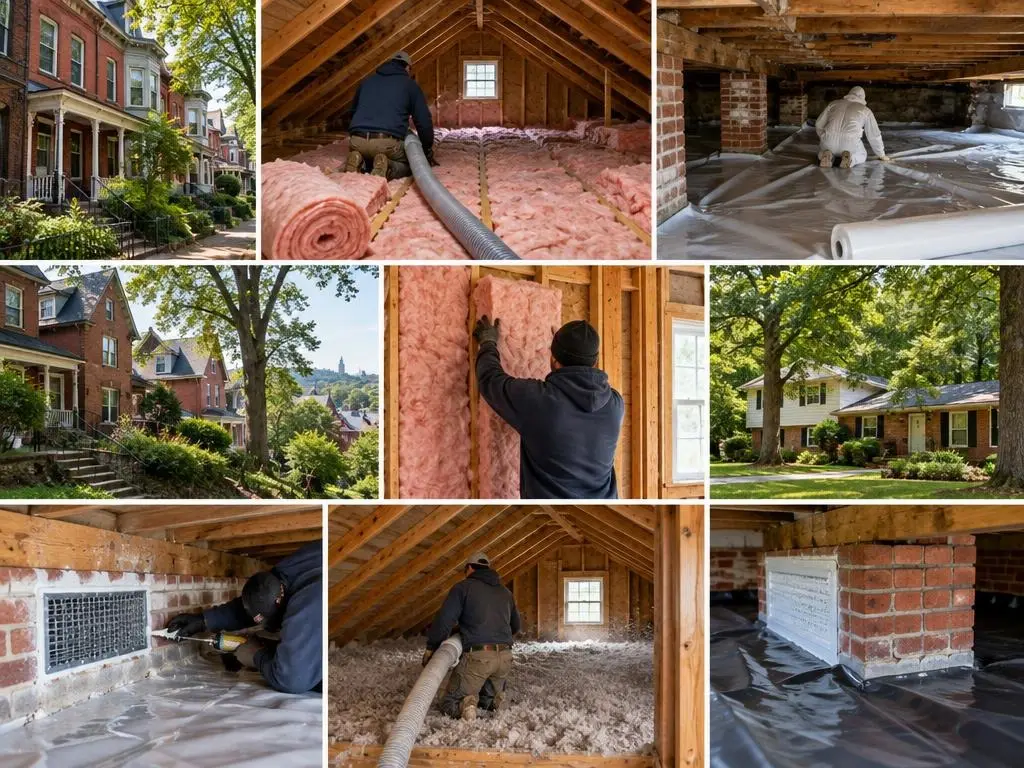
- Attic insulation: air sealing first, then a consistent depth across the whole attic floor
- Crawl space insulation and encapsulation: sealed ground covers and perimeter wall insulation
- Blown-in insulation: top-ups for settled attics and dense-packing closed walls
- Wall insulation: for additions, sunrooms and exterior walls that feel cold to the touch
- Insulation removal and replacement: pulling out old, dirty or rodent-damaged material before new goes in
What a visit looks like
We start in the attic and the crawl space or basement, because that is where most of the story is. We measure what is there, look for daylight and dust trails that show air movement, and check the bonus room from both sides when there is one. You get a written quote that lists each area, the material, the target R-value and anything we suggest leaving alone. Call (804) 293-6224 or
to set a time.Midlothian Housing at a Glance
- Mostly owner-occupied. Census ACS estimates for 2020 to 2024 show 73.5% of Midlothian homes are owner-occupied, with 2.45 persons per household, and 87.8% of residents lived in the same house one year earlier.
- Suburbs that grew with the reservoir. Subdivision growth in Midlothian sped up after Swift Creek Reservoir was created in 1965 to provide water and sewer service. It includes Brandermill, a planned development on Swift Creek Reservoir built starting in 1975, and the large Salisbury community.
- County rules, no town hall. Midlothian is an unincorporated census-designated place in Chesterfield County with no formal government, first counted as a CDP in the 2020 census, when it had 18,320 residents and 7,583 housing units.
- Ceiling R-value modification. Chesterfield County's building official issued a standing modification on December 12, 2024 allowing 2024 IRC ceiling values of R-49 compressed or R-38 uncompressed for buildings under the 2021 Virginia Residential Code.
Midlothian Questions
Why is the room over my garage in Midlothian always uncomfortable?
That room has outside air on more sides than any other room in the house: the garage below, the attic beside it and the roof above. The floor over the garage often has batts that sag away from the subfloor, and the knee walls may be open on the attic side. Closed-cell foam in the garage ceiling and sealing the knee walls usually helps more than adding a second layer of batts.
Does Chesterfield County's R-49 modification apply to my existing attic?
The December 2024 modification covers buildings constructed under the 2021 Virginia Residential Code, so it mainly affects new homes and permitted additions. For an existing attic you are adding to, we generally aim for the Department of Energy's suggested level for Climate Zone 4. If your project needs a permit, we will go by what the county inspector expects.
Should I foam my whole attic roof deck?
Sometimes. If your HVAC equipment and ducts sit in the attic, bringing the attic inside the insulated envelope can make sense. If the attic is empty and the ducts are elsewhere, air sealing the attic floor and blowing in insulation is often the simpler choice. We will tell you which way we would go for your house and why.
How long do we need to be out of the house after spray foam?
It depends on the product. EPA guidance notes that some manufacturers recommend about 24 hours before re-occupancy for professional two-component foam. We follow the label for the specific product we use and ventilate the work area during and after spraying.
Free Estimates in Midlothian, VA
Free, written estimates for Midlothian homes.
Spray Foam Insulation Near Midlothian
- Spray Foam Insulation in Richmond, VA
- Spray Foam Insulation in Henrico, VA
- Spray Foam Insulation in Short Pump, VA
- Spray Foam Insulation in Glen Allen, VA
- Spray Foam Insulation in Mechanicsville, VA
- Spray Foam Insulation in Chesterfield, VA
- Spray Foam Insulation in Chester, VA
- Spray Foam Insulation in Bon Air, VA
- Spray Foam Insulation in Petersburg, VA
- Spray Foam Insulation in Colonial Heights, VA
- Spray Foam Insulation in Hopewell, VA
- Spray Foam Insulation in Ashland, VA
- Spray Foam Insulation in Highland Springs, VA
- Spray Foam Insulation in Sandston, VA
- Spray Foam Insulation in Tuckahoe, VA
- Spray Foam Insulation in Powhatan, VA
- Spray Foam Insulation in Goochland, VA