
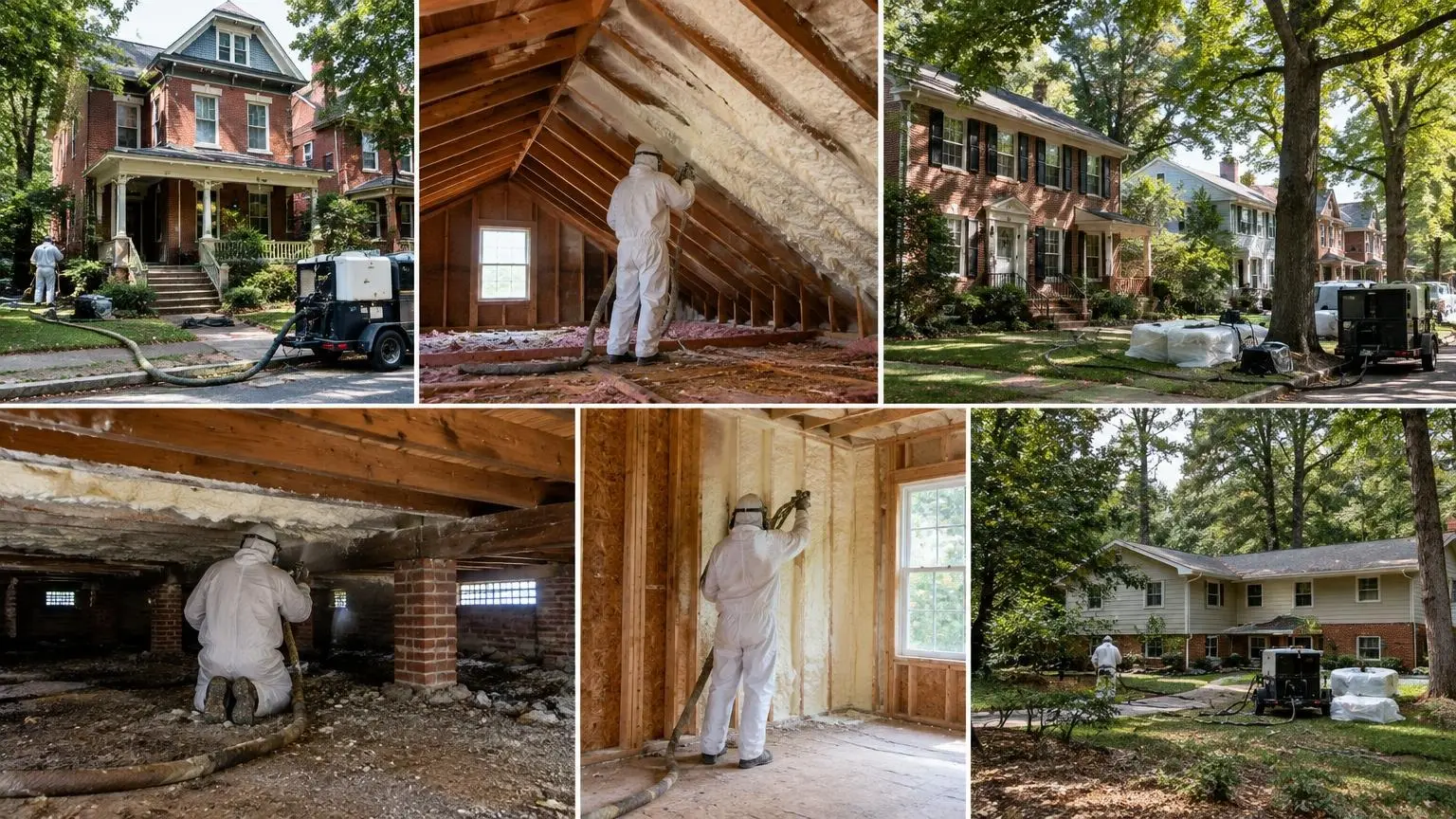
Attics, crawl spaces and walls across the city, from the Fan to Church Hill
Spray Foam Insulation in Richmond, VA
Attics, crawl spaces and walls in a city of Victorian and early-1900s neighborhoods, where July humidity averages close to 75%.
- Free on-site estimates
- Written, itemized quote with R-values
- Air sealing before any insulation goes in
Insulating a City Built Before Insulation Existed
Spray Foam Insulation in Richmond starts with the houses themselves. Much of the city's historic housing went up between the Civil War and 1940, long before anyone filled a wall cavity or measured an attic in R-values. The Fan was mostly built after the Civil War through about 1920, and the Museum District filled in between 1895 and 1940. Those homes have tall ceilings, plaster walls, deep cornices and attics that were meant to breathe, not to hold conditioned air. So every estimate here starts with what is actually in the attic, the walls and the crawl space.
Why Richmond summers drive the decision
Richmond sits in a humid subtropical climate. The city averages about 43 days a year at or above 90°F, and July relative humidity averages 74.8%. In an old house, that hot, wet air finds every gap: the top plates of interior walls, the chases around chimneys, the openings cut for knob-and-tube wiring, the loose boards of an unfloored attic. Closed-cell spray foam seals those gaps and adds insulation in one pass, which is why it gets so much attention in this climate. Open-cell foam costs less per inch and works well under a roof deck, but the Department of Energy notes it should not be used below ground level, where it can absorb water. We pick the foam for the spot, not one product for the whole house.
Neighborhoods and what they tend to need
- The Fan: late-Victorian and Edwardian rowhomes and single houses between Belvidere Street and Arthur Ashe Boulevard, many of them converted to apartments during the Great Depression. Shared party walls mean we focus on roofs, attics and rear additions.
- Museum District: mostly townhouses from 1895 to 1940, with tight attic spaces under low-slope roofs where a roof-deck foam job often beats trying to crawl in and blow loose fill.
- Church Hill: the district that holds the city's original land plat, around St. John's Church, with Greek Revival and Federal houses. Older framing here can be irregular, so we measure before we quote.
- Northside: Chestnut Hill-Plateau and Barton Heights grew with the streetcar in the late 1800s, and houses of that age are worth checking for open, vented crawl spaces.
Historic districts and what we can and cannot change
The Fan has been on the National Register of Historic Places since 1985, the West of Boulevard district (the heart of the Museum District) since 1994, and the St. John's Church district since 1970. Insulation is mostly an inside job, so it usually leaves the street face of a house alone. Where a project would touch the exterior, such as new soffit vents or an altered roofline, we will tell you before we start so you can check with the city about any review your district requires. Interior foam in an attic or crawl space does not change what people see from the sidewalk.
City permits and inspections
The City of Richmond's January 2025 Homeowners Permit Guide says a building permit is required for new construction, additions, alterations, repairs, removal and demolition, with exceptions in the code for ordinary repairs. When insulation is part of a permitted project, the city lists an inspection of the insulation before it is concealed, and construction documents for alterations must show the R-value of the new insulation. If your job is part of a renovation, we schedule our work so the inspector can see the foam before drywall goes up.
What we do in Richmond homes
- Spray foam on roof decks, attic floors, rim joists and knee walls
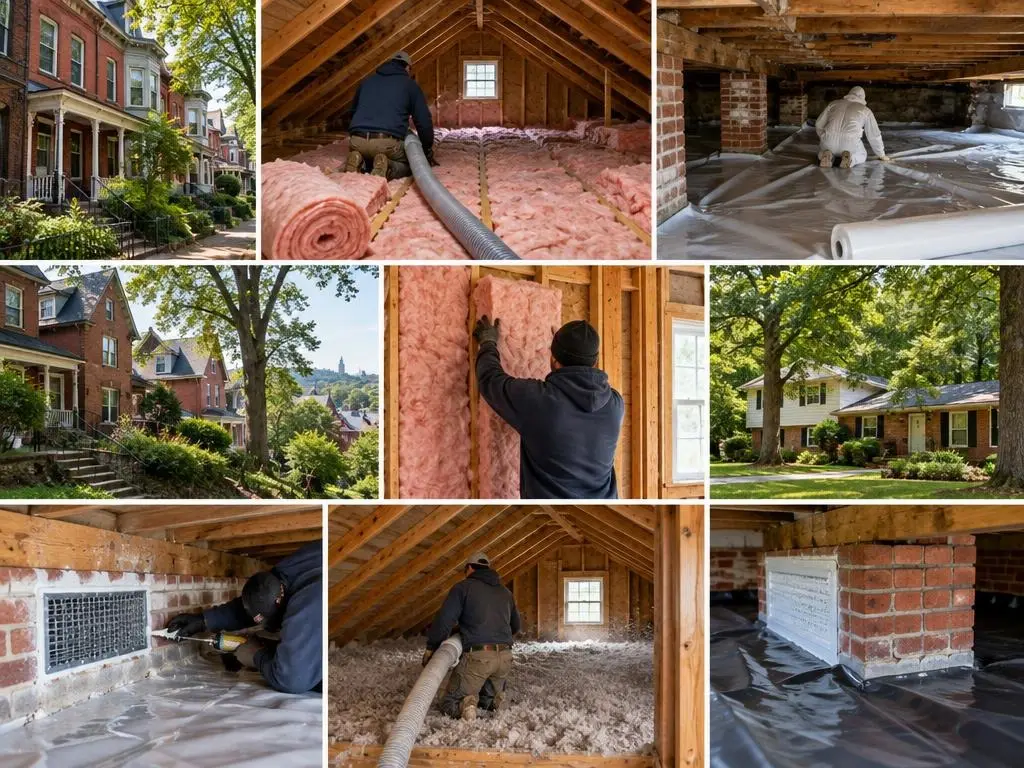
- Attic insulation upgrades, including blown-in cellulose or fiberglass over air-sealed ceilings
- Crawl space insulation and encapsulation for vented crawls under older houses
- Wall insulation for open walls during renovations
- Removal and replacement of old, wet, rodent-damaged or settled insulation
If we find old loose fill or pipe wrap we cannot identify, such as vermiculite, we stop and recommend testing by an accredited professional before anyone disturbs it. The EPA advises treating doubtful material as if it contains asbestos and not sampling it yourself.
Getting a written estimate
Call (804) 293-6224 or ask for an estimate online. We look at the attic, the crawl space and any walls you want opened, take notes on moisture and air leaks, and give you a written quote that lists each area, the material, the thickness and the target R-value. Every quote is free.
Richmond Facts That Shape an Insulation Job
- Hot, humid summers. Richmond has a humid subtropical (Cfa) climate. July's daily mean is 79.3°F, the city averages about 43 days a year at or above 90°F, and July relative humidity averages 74.8%.
- Winters still matter. January's daily mean is 37.9°F and downtown averages 84 nights of frost a year, with an average first freeze around October 30 and last freeze around April 10.
- The Fan's housing age. The Fan was primarily developed after the Civil War through about 1920, moving from tobacco fields in 1880 to almost fully built by the 1920s. It was added to the National Register of Historic Places in 1985.
- Museum District townhouses. The Museum District was mostly built between 1895 and 1940, largely as townhouses. The West of Boulevard Historic District, about 249 acres, was listed on the National Register on March 7, 1994.
- A city of renters and owners. About 43.5% of Richmond housing units are owner-occupied (Census ACS 2020-2024), and the city counted 226,610 residents in the 2020 census.
- Insulation inspected before cover. The City of Richmond Homeowners Permit Guide (January 2025) lists an inspection of energy conservation material (insulation) prior to concealment among its minimum inspections, and asks for the R-value of new insulation on alteration plans.
Richmond Questions
Can you spray foam a Fan District rowhouse without touching the outside?
In most cases, yes. Foam goes on the underside of the roof deck, the attic floor, rim joists or the crawl space, all from the inside. If a job would need exterior changes, such as new vents, we raise it before quoting so you can check whether your historic district needs a review.
Is closed-cell or open-cell better for an old Richmond house?
It depends on the location in the house. Closed-cell foam resists moisture and air leakage better and has a higher R-value per inch, so we lean on it in crawl spaces and on rim joists. Open-cell is lighter and less expensive and can make sense on a roof deck. The Department of Energy advises against open-cell below ground level.
Do I need a permit to insulate my attic in Richmond?
The city's permit guide says permits cover alterations and repairs, with code exceptions for ordinary repairs, and it does not single out insulation-only jobs. When insulation is part of a permitted renovation, the city inspects it before it is covered. Call the city's permit office if you are unsure, and we will follow whatever it tells you.
How long do we need to stay out of the house after spray foam?
Plan on about a day. An archived EPA page notes that some manufacturers recommend about 24 hours before re-occupancy for professional two-component foam, and that the time can vary by product. We give you the product's specific time with your quote.
Free Estimates in Richmond, VA
Free written estimates anywhere in the city of Richmond.
Spray Foam Insulation Near Richmond
- Spray Foam Insulation in Henrico, VA
- Spray Foam Insulation in Short Pump, VA
- Spray Foam Insulation in Glen Allen, VA
- Spray Foam Insulation in Mechanicsville, VA
- Spray Foam Insulation in Chesterfield, VA
- Spray Foam Insulation in Midlothian, VA
- Spray Foam Insulation in Chester, VA
- Spray Foam Insulation in Bon Air, VA
- Spray Foam Insulation in Petersburg, VA
- Spray Foam Insulation in Colonial Heights, VA
- Spray Foam Insulation in Hopewell, VA
- Spray Foam Insulation in Ashland, VA
- Spray Foam Insulation in Highland Springs, VA
- Spray Foam Insulation in Sandston, VA
- Spray Foam Insulation in Tuckahoe, VA
- Spray Foam Insulation in Powhatan, VA
- Spray Foam Insulation in Goochland, VA